WHAT WE
MADE HAPPEN
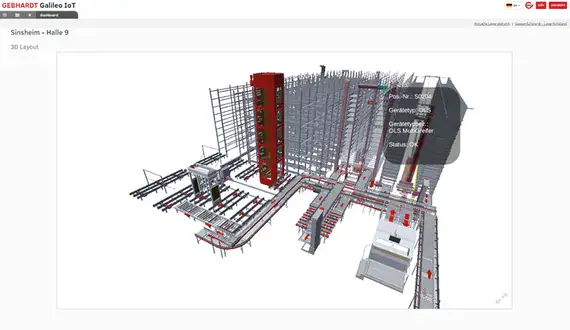
The live environment is GEBHARDT’s 1,200-square-meter logistics center in Sinsheim, operational since 2018. It now serves as both an internal logistics benchmark and a testbed for alliance members. The deployed solution includes GEBHARDT Cheetah operating devices and StoreBiter® shuttles (OLS and MLS), powered by Dunkermotoren’s BG66 and BG75 motors. These were connected through standardized AAS structures, visualized in Galileo IoT® and integrated into both the GEBHARDT and Dunkermotoren cloud platforms.
Notably, the project goes beyond individual architectures and enables cloud-to-cloud integration via MQTT, laying the foundation for a universal, cross-company architecture.
- Real production environment: GEBHARDT warehouse in Sinsheim
- Motor data (BG66, BG75) connected via AAS
- Integration into Galileo IoT® and Dunkermotoren cloud
- Real-time digital twins for maintenance prediction
- Cloud-to-cloud architecture with MQTT and AAS standard
- Data visualization directly within Galileo IoT® (no custom dashboards)
- Implementation Award winner by OI4
 At Hannover Messe, we showed an example of how we will access one of our motors in one of the GEBHARDT shuttles live via a tablet in the GEBHARDT warehouse. We can also show the status data visually in a standardised way, i.e. not in the form of a demo programmed for trade fair purposes that only works in a specific configuration. At GEBHARDT, the visualisation of the standardised status data provided via the AAS is carried out directly in Galileo® IoT without having to integrate separate dashboards for example.
THE CHALLENGE
WE SOLVED
Crucially, the project tackled fail safety as a practical requirement. The aim was to detect anomalies in motor behavior within the shuttles before they lead to breakdowns. To achieve this, the team focused on an Alliance-compliant integration based on the Asset Administration Shell, which defines Digital Twins in particular. The various shuttles in the warehouse are not only physically present but also virtually integrated via their digital twins into the overarching cloud architecture of the Alliance. This enables standardized, reliable real-time monitoring with the goal of predictive maintenance and the avoidance of downtime in warehouse operations. The implementation at GEBHARDT’s Innovation Center proves that such monitoring is not only feasible, but can be rolled out rapidly, even in brownfield settings.


THE TEAM
THAT DELIVERED


WHY THE RESULTS
MATTER (AND FOR WHOM)

Beyond its technical success, the project is being continuously expanded with contributions from other OI4 members. Partners such as Captron, Bizerba, ifm, Pepperl+Fuchs, Sick, Phoenix Contact, and SAP are bringing in technologies including touch switches, weighing systems, sensor data analysis, energy management, and cloud-based data evaluation. This makes the solution increasingly robust and multidimensional, offering direct value to logistics teams, component suppliers, and system integrators alike.
BETTER
TOGETHER
This project shows what’s possible through collaborative implementation. It invites other members to reuse, adapt, and extend the solution turning best practices into shared progress within the OI4 Alliance.
With use cases implemented across six OI4 process houses — Asset Onboarding, Condition Monitoring, Process Twin, Product Twin, Enterprise Logistic, and Cross Enterprise — the initiative demonstrates real-world, multi-partner integration. It’s not a pilot or showcase but a fully implemented setup that continues to grow with each new member.
As the project evolves, it provides an almost out-of-the-box path for other Alliance members to join and benefit from an interoperable, production-ready intralogistics platform.
Sounds interesting to you? Register here: