

in a
nutshell
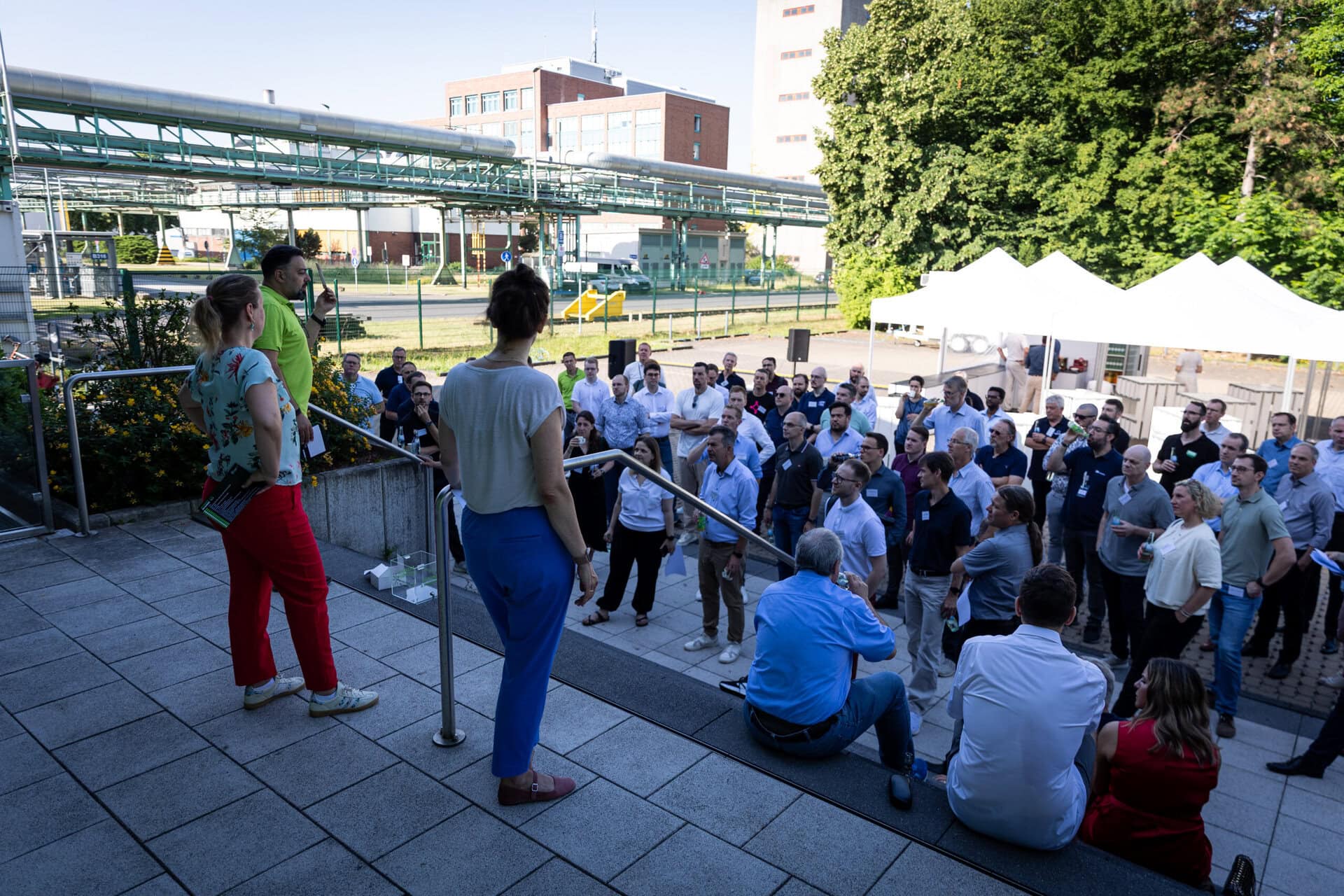
Two days, countless conversations and one shared conviction: industrial digitalization works best when companies work together. From inspiring discussions to more than 16 collaborative demonstrators, the OI4 Innovation Event for the Process Industry showed that openness, interoperability and a strong community are turning ideas into practical solutions. Because the biggest breakthroughs rarely come from one company alone. They happen when an ecosystem moves forward together.
event
sponsors


A big thank you also goes to our sponsors Endress+Hauser, SAP and PiLog Group for making this event possible. Interested in becoming a sponsor or partner at one of our upcoming events? We’d love to hear from you.
Our next events are already just around the corner. Join us, become part of the conversation and discover how you can get involved. Get in touch with us!
about
the event
The OI4 Innovation Event for the Process Industry wasn’t just another conference about industrial digitalization. It was two days dedicated to one simple idea: progress happens faster when companies stop working in isolation.
Bringing together plant operators, technology providers, research organizations, software companies, associations and industry experts from the Open Industry 4.0 Alliance and NAMUR, the event created a space where discussions quickly turned into collaboration. Participants explored how technologies such as Digital Twins, the Asset Administration Shell, Industrial AI, Software Defined Automation, Modular Type Package (MTP), PA-DIM and interoperable data exchange are already being applied in industrial environments today. The focus was not on future visions or buzzwords, but on practical implementation, open standards and lessons learned from real projects.
Throughout the sessions, experts shared concrete experiences from industrial deployments, discussed architectural decisions, implementation challenges and organizational aspects, giving participants practical guidance for their own digital transformation initiatives. The event showed how technologies, standards and collaboration come together to create scalable solutions that deliver value beyond individual pilot projects.
That mindset became even more tangible on the second day. More than 16 demonstrators showed what happens when companies build together instead of side by side. Rather than presenting isolated products, many demonstrations combined technologies, expertise and ideas from multiple organizations. Around every demonstrator, new conversations started, experiences were shared and connections were made between people tackling similar challenges from different perspectives.
What stayed with many participants was not a single presentation or technology, but the atmosphere throughout the event. There was a genuine willingness to exchange knowledge, challenge ideas and help each other move one step further. It became clear that interoperability is about more than systems communicating with each other. It starts with companies that are willing to collaborate, share experience and build on common standards. That community spirit was visible in every discussion, every demonstrator and every new connection made over the two days.
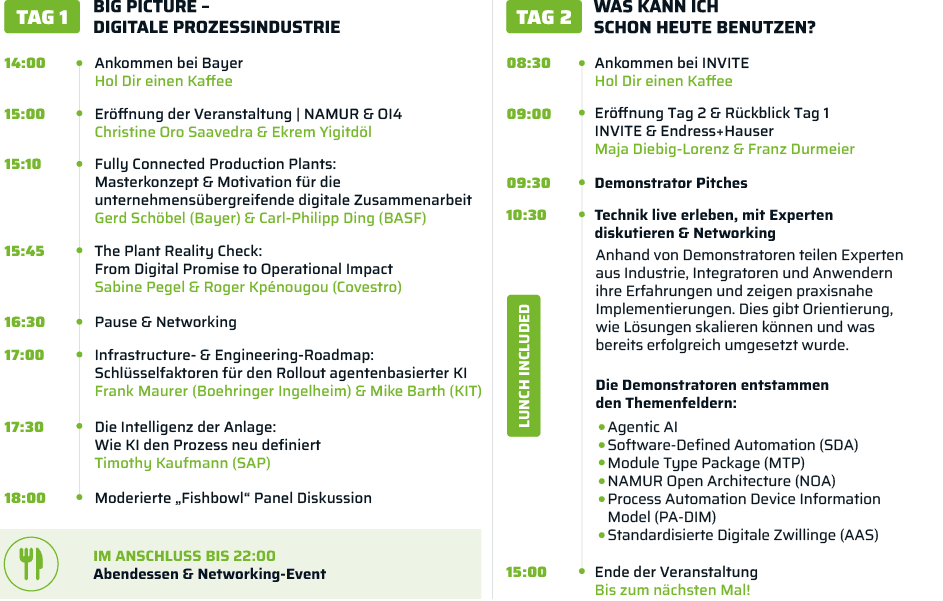
Agenda
(german)

Better together
-demonstrators
“Digitales Kalibrierzertifikat“ | Roche, Boehringer Ingelheim, E+H, Conplement & Beamex | AAS
What is it about?
The demonstrator shows the seamless integration of Digital Calibration Certificates (DCCs) into the concepts and architecture of the Asset Administration Shell (AAS), enabling automated and fully digital calibration workflows.
Benefits at a Glance
- Significant savings when exchanging calibration data between systems and organizations
- Fully digital calibration processes, eliminating manual steps and time-consuming procedures
- Improved quality and enhanced safety
“KI-sy Twin Demonstrator“ | Process-X-Konsortium & Fraunhofer | AAS | PA-DIM | NOA
What is it about?
The demonstrator shows how AI can be used to automatically digitalize existing plants (brownfield), generate Asset Administration Shells (AAS) and create digital twins, including 3D models, while integrating data spaces and secure IT/OT connectivity.
Benefits at a Glance
- Fast and automated digitalization of existing plants
- Continuous use and updating of plant documentation
- Standardized interoperability through the AAS across different systems and tools
- Efficient data exchange while preserving data sovereignty
- Improved automation, analytics and process optimization
- Integrated cybersecurity for secure IT/OT connectivity
“AAS-basierter Datenaustausch im Engineering“ | Bürkert & Siemens | AAS
What is it about?
Experience how AAS-based data intelligently extends the COMOS real device catalog, enabling seamless, data-driven engineering from process planning and instrumentation to electrical engineering.
Benefits at a Glance
- Seamless data integration: AAS-based data is integrated directly into the COMOS real device catalog and is consistently available across all engineering disciplines.
- More efficient engineering: A unified data foundation accelerates and simplifies processes from process planning and instrumentation to electrical engineering.
- Higher data quality and transparency: Up-to-date, standardized device data reduces errors, increases planning reliability and improves traceability throughout the entire project.
“Bergkamen Process X: Digitalisierung von Bestandsanlagen” | Bayer , Arvato DT , WIKA , Krohne | AAS | NOA | Datenraum
What is it about?
The demonstrator showcases the implementation of a NOA-based digitalization concept using Asset Administration Shells (AAS) for a brownfield process plant, creating a continuous digital twin without modifying existing systems.
Benefits at a Glance
- Continuous engineering data flow and consistent as-is documentation
- Greater transparency and improved decision-making through centralized data availability
- Step-by-step digitalization without disrupting ongoing operations
- Foundation for applications such as predictive maintenance and process optimization
“Gebäudeautomatisierung NE196“ | Bayer | AAS
What is it about?
The demonstrator showcases AI-powered capabilities around the Asset Administration Shell (AAS), including standardized generation of digital twins, intuitive interaction through a chatbot and automated analysis of plant performance.
Benefits at a Glance
- AI-generated AAS based on NE196: Standardized and modular Asset Administration Shells significantly reduce engineering effort for creating and instantiating digital twins, with lifecycle information already structured and linked to established repositories such as bsDD and ECLASS.
- Chatbot for AAS interaction (BaSyx): An intuitive interface enables operators to interact naturally with digital twins, access relevant information on demand and reduce the need for manual data searches or specialized IT knowledge.
- Automated performance assessment: The tool automatically generates KPIs, trends and performance overviews, eliminating manual engineering effort while enabling faster identification of faults and opportunities for energy optimization.
“Hey Kolonne – Intelligente Unterstützung für Brownfieldanlagen” | Invite, Bayer, Namur | AI
What is it about?
The demonstrator explores the potential of using Large Language Models (LLMs) to support plant operators, taking into account data availability, expert knowledge and the constraints of brownfield environments.
Benefits at a Glance
- Proof of feasibility: Evaluates which questions can be answered using existing brownfield data and where expert knowledge is still required.
- Structured data foundation: Defines requirements for data models that connect general AI knowledge with plant-specific context.
- Efficient knowledge management: Systematically contextualizes existing datasets to improve the availability and use of operational knowledge.
“MTP zum Anfassen“ | ZETA, COPA DATA | MTP
What is it about?
Experience the next generation of modular automation with the ZETA Cubes. The demonstrator shows how production plants can be configured using the Module Type Package (MTP) standard, where individual cubes represent modular process units such as mixing, buffering or chromatography. Each module is automatically detected via RFID and integrated into the process control system without manual engineering, making the plant immediately available in the Copa-Data zenon POL environment.
Benefits at a Glance
- Plug & Produce in practice: Modules are automatically detected and integrated without manual engineering.
- Reduced engineering effort: Standardized MTP integration significantly simplifies plant configuration and commissioning.
- Maximum flexibility: Production plants can be easily reconfigured or expanded by adding or replacing modular units.
- Open and scalable architecture: Demonstrates how modular concepts and open standards support the future of the process industry.
“MTP 2.0 — Plug & Produce mit MTP“ | Beckhoff, Festo | MTP
What is it about?
Festo and Beckhoff jointly showcase their Module Type Package (MTP) solutions, demonstrating seamless modular plant integration. In a live demonstration, a Festo module is integrated into the Beckhoff system to illustrate simple, standardized and vendor-independent interoperability.
Benefits at a Glance
- Standardized objects with uniform interfaces
- Defined workflows through a standardized service state machine
- Automated integration
- Vendor-independent interoperability
“MTP Enabled NOA Robotics” | Invite | MTP
What is it about?
The demonstrator showcases the standardized integration of mobile robots into process plants based on NAMUR Open Architecture (NOA) and Module Type Package (MTP). The goal is scalable, vendor-independent robotic integration, particularly for brownfield environments.
Benefits at a Glance
- Plug & Produce: Fast integration of mobile robotics
- Scalable: Easily transferable across different plants and locations
- Brownfield-ready: Enables digitalization without extensive plant modifications
- Vendor-independent: Standardized integration of different robotic systems into various software environments
- Mobile sensing: Uses established process sensors mounted on mobile robots
“NOA challenges for Scalable AMS” | Invite, Bayer | NOA
“SDA-Wall“ | Flecs, Kubermatic, Boehringer Ingelheim, KIT, Logiccloud | SDA
What is it about?
The demonstrator showcases Software Defined Automation in practice: an open, scalable infrastructure that enables containerized automation applications to be developed independently of hardware, deployed through a central DevOps platform and orchestrated across devices and vendors.
Benefits at a Glance
- Decoupled software and hardware: Flexible, portable automation solutions that work across vendors and can be updated with ease
- Scalable deployment and lifecycle management: CI/CD and centralized management enable continuous deployment and operation of automation applications
- Open, interoperable ecosystem: A multi-vendor approach accelerates innovation, reduces fragmentation and increases efficiency in industrial production
“Modular Control and Realtime Data Exchange” | Hilscher, Xentara, Fraunhofer | SDA
What is it about?
The Fraunhofer IPT “Juggler” demonstrator showcases how a complex control task is implemented using a traditional automation approach. Over the coming months, the system will be transformed into an SDA-enabled demonstrator, illustrating how real-time, time-synchronized communication between distributed, containerized OT control functions and IT/IoT applications on edge devices can be realized. The project also invites interested industry partners to contribute, with the goal of jointly presenting the results at SPS 2026.
Benefits at a Glance
- For machine builders and automation engineers: Deterministic, interoperable IT/OT communication enables flexible, software-based machine concepts.
- For end users: Clearly defined use cases, evaluated standards and reference architectures provide practical guidance for Software Defined Automation.
- For developers and operators: Technology evaluations and compatibility assessments (e.g. SDA/Margo) provide a solid foundation for interoperable, real-time edge control solutions.
“Qualität im Takt — der Umplanungsagent in der Prozessindustrie” | SAP, Uhlmann | AAS, AI, MTP, NOA
What is it about?
The demonstrator showcases an intelligent agent that monitors production, detects disruptions at an early stage and automatically replans batches and resource allocation.
Benefits at a Glance
- Reduces manual effort
- Minimizes downtime
- Enables data-driven decision-making during live operations
“Factory-X-Datenaustausch über Unternehmensgrenzen” | TÜV Süd, Bayer, SAP, Codewerk, Siemens, Uhlmann, BASF | AAS
What is it about?
The demonstrator shows how automated data exchange based on the Factory‑X standard reduces the effort required for process inspection management and execution.
Benefits at a Glance
- Reduced effort for plant operators and service providers: Less time spent creating data, handling follow-up questions, preparing inspection reports and locating relevant information on site
- Improved data reuse: Inspection data can be directly reused for inspection preparation, defect management and shutdown planning
“Agentic Digital Twin in der Anwendung” | Comsysto Reply, Intersystems | AI
What is it about?
The demonstrator shows how an AI agent becomes a context-aware assistant through an AAS-based digital twin rather than simply acting as a data search tool. Using a 3D printing process as an example, live data, quality metrics, maintenance information and business KPIs are semantically combined, analyzed in InterSystems IRIS and made accessible through a natural language chat interface. Instead of providing raw data alone, the agent understands context such as asset relationships, units, thresholds, data sources, freshness and permitted actions, enabling meaningful recommendations without navigating multiple systems and dashboards.
Benefits at a Glance
- Faster root cause analysis for quality issues, disruptions and operational deviations
- Better decision-making by combining live data, KPIs, quality, maintenance and cost information
- Reduced manual effort for data collection, analysis and action planning
- Greater transparency into asset condition, OEE, scrap rates, maintenance needs and operational performance
- Scalable approach across multiple machines, production lines, sites and asset types
- Improved traceability of recommendations through clear data sources, data freshness and documented assumptions
- Support for secure operations through defined permissions and authorized actions
- Foundation for use cases such as predictive maintenance, quality improvement and production optimization