


The Challenge
We Tackled
Lintzen Feinmechanik GmbH runs its production and administration largely with manual, paper-based processes and disconnected IT systems. This results in data gaps, inconsistent information and slow handovers between departments. There is no end-to-end link from shopfloor to management level, which limits transparency, traceability and data-driven control. The core challenge was to define a realistic way to break these media silos and build an integrated system landscape without disrupting daily operations or overloading a small organization.
Who was
Participating?


Why this project
matters and for who
This project is relevant for small industrial companies that want to digitalize and automate their operations in a controlled and economically feasible way. It addresses organizations that struggle with fragmented processes, limited transparency and inconsistent data across production, planning and administration. For Lintzen Feinmechanik, the focus was on creating tangible added value through higher efficiency, reliable and consistent data, better coordination along the value chain and improved information security. More broadly, the approach offers a practical blueprint for traditional factories that need a structured and realistic entry point into digital transformation.

What we’ve
achieved
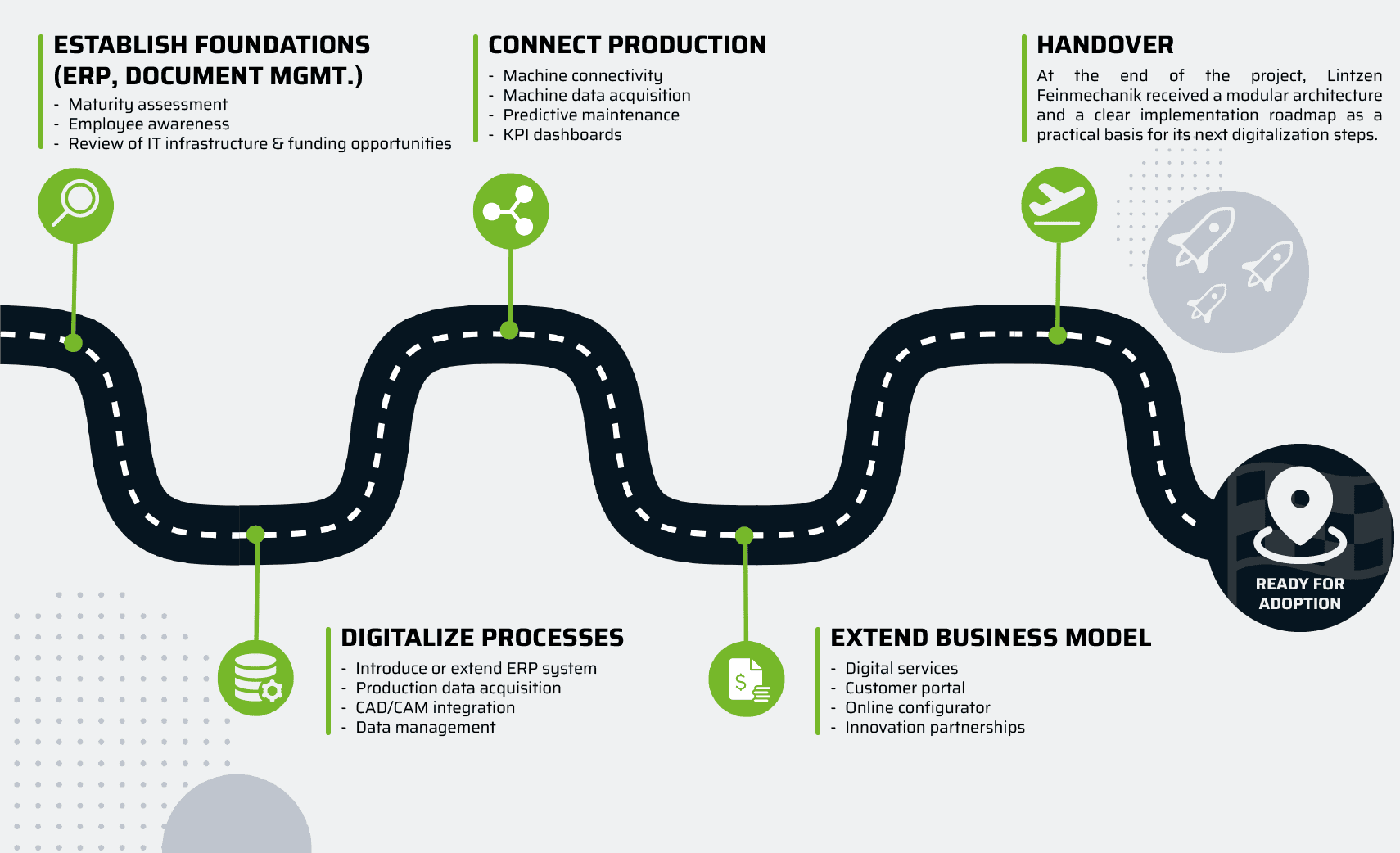
The project delivered a concrete digitalization concept tailored to Lintzen Feinmechanik’s current maturity level. A modular system architecture was defined that covers ERP and MES integration, machine connectivity, data management, cyber security and future AI use. On this basis, a structured implementation roadmap was created that puts these modules into a clear sequence and shows how media breaks can be reduced, systems can be linked and data can be made usable across operational and strategic levels. Together, these results provide a practical and ready-to-use foundation for starting the company’s digital transformation.

what we
learned
The project showed that step-by-step digitalization and automation is realistic and economically feasible even for a small, traditionally structured industrial company. A modular architecture combined with a clearly structured roadmap makes it possible to reduce media breaks in a targeted way and improve processes sustainably.
It also became clear that digital transformation is not only a technical task, but equally an organizational, process-related and security-related one. Early consideration of cyber security, as well as vertical and horizontal integration, is a decisive success factor for building a stable and future-proof system landscape.
What’s
next?
As a next step, the defined modules can be implemented gradually, starting with an ERP system and digital document management. This can be followed by machine connectivity and an MES to increase transparency and data availability, with further expansion toward automation and data-based optimization in later stages.

curious To
learn more?
If you want to explore how a modular, step-by-step digitalization roadmap can work in practice for a traditional manufacturing company, get in touch with the Open Industry 4.0 Alliance. We are happy to share insights from the project and discuss how a similar approach could be applied in your production environment.