


SPS
Smart
Production
Solutions
Visit us in Hall 5
booth 160 & 161
24–26 November, Nürnberg
At SPS 2026, the OI4 booth is all about The Power of Many: member companies, projects and technologies
coming together to demonstrate how open, interoperable industrial ecosystems work in practice.
meet our
co-exhibitors
The following OI4 members and partners will be joining us as co-exhibitors at our booth, bringing their own expertise, solutions and use cases to the OI4 ecosystem. Meet the teams of:

the oi4
areas
Software-Defined Automation
Discover Software-Defined Automation in action in our dedicated SDA Area.
At its center is a joint demonstrator developed by nine OI4 members, showing how software-defined approaches can connect different technologies and components in an open, interoperable automation environment.
Directly next to the demonstrator, the open-source Margo initiative will showcase its approach to interoperable edge infrastructure and application deployment. Opposite the SDA Area, our co-exhibitors COPA-DATA and FLECS Technologies bring additional expertise from the automation ecosystem.
Together, they make the SDA Area the place to discuss Software-Defined Automation within the OI4 community and beyond.
Digital Calibration Certificate
Discover Digital Calibration Lifecycle in action and see how calibration data can become part of a fully digital workflow.
At its center is the OI4 project on Digital Calibration Certificates (DCC) and Digital Calibration Requests (DCR), showing how calibration information can be exchanged in a standardized, machine-readable format using the Asset Administration Shell (AAS).
The project brings together companies from across the ecosystem to develop practical guidance, validate real use cases, and demonstrate how calibration data can move seamlessly between manufacturers, service providers, and operators.
Together, these activities show how DCC can reduce manual effort, improve interoperability, and support more efficient digital quality and asset management.
Industrial Cyber Security
Discover Industrial Cyber Security in action with our work on secure device identity and onboarding.
At its center is the OI4 Device Identity project, showing how modern industrial devices can be securely identified and integrated into operational environments using cryptographically protected identities. Building on standards such as IEEE 802.1AR and RFC 5280, the project explores how manufacturer device identities can be used to issue operational certificates for secure communication.
The workgroup is developing a manufacturer-independent and protocol-agnostic provisioning framework, including defined certificate profiles, a clear file system structure, and a reproducible demonstrator environment.
Together, these activities show how secure device onboarding can enable trusted identification, authentication, and communication across industrial networks.
🎤the oi4
stagetalks
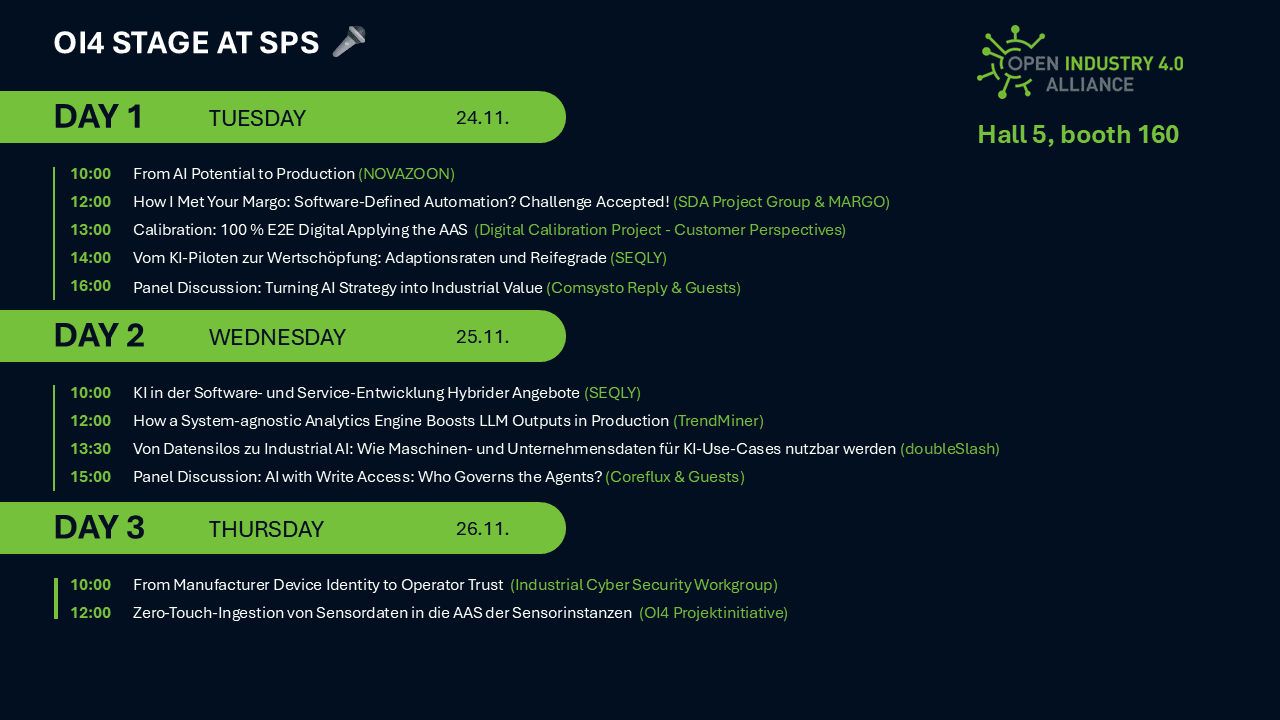
Throughout all three days of SPS, the OI4 Stage will host talks and discussions on topics including open industrial ecosystems, interoperable automation, digital production and practical implementation examples from the OI4 community.
Daily at the OI4 booth – Hall 5, Booth 160 & 161.
about the
stagetalks
From AI Potential to Production: Making AI Work for SME (Novazoon)
Speaker: Tobias Butsch, Managing Consultant at Novazoon
Why you should come: Endless planning, scattered use cases, PoCs without real value: many AI initiatives in mid-sized companies cost time and money without delivering business benefits. It’s not a lack of ideas, it’s the lack of the right lever for implementation. Using the example of a mid-sized machinery manufacturer from Baden-Württemberg, the talk shows how to systematically identify potentials with real bottom-line impact and realize them measurably in operations within just three months.
Language: German
When: Tuesday 24, 10 AM
How I Met Your Margo: Software-Defined Automation? Challenge Accepted! (SDA Project Group & MARGO)
Speakers:
Christian Platzer, Schneider Electric
Moritz Berner, COPA-DATA
Daniel Kerkhoff, Beckhoff
Samuel Greising, FLECS
Why you should come:
Four companies take the stage together to show how the open Margo standard from the Linux Foundation lets apps from any vendor run and scale on any edge device. You’ll see what software vendors, device manufacturers, and edge-stack providers each contribute, and why plant operators can cut onboarding effort per edge device by up to 75% and update costs by 69%. You’ll also leave with something to try: with three commands, your existing app becomes a validated Margo app, free, open source and with no account needed.
Language: German
When: Tuesday 24, 12 PM
Calibration: 100% E2E Digital Applying the AAS (Digital Calibration Project)
Speakers: Siegfried Hackl (dsihac) & Michael Clever (Roche)
Why you should come: The Digital Calibration Request (DCR) and Digital Calibration Certificate (DCC) enable a fully standardized and automated process for external calibrations, going far beyond a digital certificate to a fully digitalized end-to-end process. By eliminating manual checks and enabling automated integration via the Asset Administration Shell (AAS), compliance risks are minimized and drastic time savings are achieved. In addition, automated validation ensures significantly higher data quality and integrity.
Language: German
When: Tuesday 24, 1PM
Vom KI-Piloten zur Wertschöpfung: Adaptionsraten und Reifegrade (SEQLY)
Speaker: Kristian Schatz, Director Strategic Consulting
Warum du kommen solltest: Industrial AI ist das Schwerpunktthema der SPS 2026 und gleichzeitig der Bereich, in dem Anspruch und Realität oft am weitesten auseinanderliegen. Viele KI-Projekte kommen nicht über die Pilotphase hinaus. Dabei ist selten die Technologie der entscheidende Faktor, sondern der Reifegrad, mit dem ein Unternehmen KI einsetzt.
Der Vortrag ordnet diese Reifegrade anhand eines praxisnahen Modells ein: von ersten Experimenten über wiederholbare Anwendungen bis hin zum produktiven, kontrollierten Einsatz. Ein besonderer Fokus liegt dabei auf dem souveränen Umgang mit KI. Unternehmen sollen Kompetenzen, Daten und Entscheidungshoheit im eigenen Haus behalten, anstatt sie unbemerkt an Plattformanbieter abzugeben.
Der Vortrag zeigt, was nötig ist, um KI-Initiativen aus der Pilotphase in die Praxis zu bringen: tragfähige Anwendungsfälle, ein klares Zielbild und die richtige Reihenfolge bei der Umsetzung.
Language: German
When: Tuesday 24, 2PM
Panel Discussion: Turning AI Strategy into Industrial Value (Comsysto Reply + Guests)
Panelists: Jan Nowak (Comsysto Reply) , Tobias Butsch (Novazoon) + Ruth Markut-Kohl (Engel) + Marius Grathwohl (Multivac)
Warum du kommen solltest: „Das macht schon irgendwer.“ Diesen Satz kennt vermutlich jeder, der in der Industrie arbeitet. Und genau hier beginnt ein Problem, das oft unterschätzt wird: Prozesse sind in vielen Unternehmen lückenhaft, veraltet oder existieren nur in den Köpfen einzelner Mitarbeitender. Das kostet Zeit, Qualität und Wissen und bremst nicht zuletzt jede KI-Strategie aus, bevor sie in der Produktion ankommt.
Gemeinsam mit Experten aus Produktion, Qualitätsmanagement, IT/OT und Forschung möchten wir den Weg von der KI-Strategie bis zum messbaren Mehrwert beleuchten. Folgende Impulsfragen sollen die Diskussion leiten:
Language: German or English — depending on the audience
When: Tuesday 24, 4 PM
KI in der Software- und Service-Entwicklung Hybrider Angebote (SEQLY)
Speaker: Kristian Schatz, Director Strategic Consulting
Warum du kommen solltest: Bei hybriden Angeboten aus Hardware und Software entscheiden zunehmend die digitalen Komponenten an der Schnittstelle zum Kunden und Anwender über Differenzierung und Kundenbindung. Dennoch orientieren sich ihre Entwicklungszyklen häufig noch immer am Tempo der Hardwareentwicklung.
Der Vortrag zeigt, wie KI die Entwicklung digitaler Services beschleunigen kann: von der Anforderungsanalyse über Schnittstellen- und UX-Design bis hin zu Implementierung, Dokumentation, Testing und kontinuierlicher Weiterentwicklung.
Da Geschwindigkeit ohne klare Prioritäten lediglich dazu führt, dass die falschen Dinge schneller entwickelt werden, verbindet der Vortrag KI-gestützte Entwicklung mit einer ganzheitlichen Betrachtung des Produkt- und Serviceportfolios.
Anhand eines anonymisierten Praxisbeispiels aus der Kombination von Sensorik und Software wird gezeigt, wie sich höhere Entwicklungsgeschwindigkeit in echten Kundennutzen übersetzen lässt.
Language: German
When: Wednesday 25, 10 AM
How a System-agnostic Analytics Engine Boosts LLM Outputs in Production (TrendMiner)
Speaker: Dr.-Ing. Lukas Pansegrau, Senior Solution Manager at TrendMiner
Why you should come:
Large language models can draft a shift report in seconds, but ask one why throughput dropped on line 3 last Tuesday and it will often guess. The problem is not the model. It is the gap between the LLM and the time-series data that actually describes your process: scattered across historians, MES, and lab systems, and rarely in a form an LLM can reason over reliably.
In this session, we show how TrendMiner closes that gap. As a system-agnostic analytics engine, TrendMiner connects to your existing data sources without migration, contextualizes sensor data with events and asset structure, and runs the heavy analytical work itself: pattern recognition, fingerprint comparisons, anomaly detection, and event analytics. The LLM then works with computed, traceable results instead of raw tags or assumptions.
Language: English
When: Wednesday 25, 12 PM
Von Datensilos zu Industrial AI: Wie Maschinen- und Unternehmensdaten für KI-Use-Cases nutzbar werden (doubleSlash)
Speaker: Danny Claus, Head of Business Unit Solutions at doubleSlash Net-Business GmbH
Warum du kommen solltest: Maschinen, Anlagen und Unternehmenssysteme erzeugen große Datenmengen. Häufig sind diese Daten jedoch auf verschiedene Systeme verteilt, verwenden uneinheitliche Begriffe und unterscheiden sich in ihrer Qualität. Das erschwert einen gemeinsamen Blick auf Produktion und Service, kostet Zeit bei der Analyse und bremst KI-Projekte aus.
Echter Mehrwert entsteht, wenn Maschinen- und Produktionsdaten mit Informationen aus ERP, MES, PLM und Service verknüpft, in ihren geschäftlichen Kontext eingeordnet und hinsichtlich ihrer Qualität geprüft werden.
Der Vortrag zeigt, wie klare Verantwortlichkeiten und wiederverwendbare Datenprodukte eine verlässliche Grundlage für Transparenz in der Produktion, vorausschauende Wartung (Predictive Maintenance) und den Einsatz von KI im Betriebsalltag schaffen.
Language: German
When: Wednesday 25, 1:30 PM
Panel Discussion: AI with Write Access: Who Governs the Agents? (Coreflux + Guests)
Panelists: Hugo Vaz (Coreflux), Dorian Gast (Concept Reply), Michael Riester (OI4 Alliance), Thomas Baur (GEA)
Why you should come: Industrial AI is moving from dashboards to direct action. Agents now diagnose, prescribe and change settings on the machine. That raises one question: who is accountable when AI Agents change a setpoint? Hear standards, integration and platform experts discuss on this.
Language: English
When: Wednesday 24, 3PM
From Manufacturer Device Identity to Operator Trust (OI4 Industrial Cyber Security)
Speaker: [tbc]
Why you should come: [abstract to follow]
Language: [tbc]
When: Thursday 26, 10AM
Zero-Touch-Ingestion von Sensordaten in die AAS der Sensorinstanz (OI4 Projekt)
Speaker: Christian Heinrich
Warum du kommen solltest: Wird ein neuer Sensor in der Produktion installiert, stehen seine Live-Daten meist ohne den nötigen Kontext zur Verfügung. Die Zuordnung zur richtigen Anlage, die Bedeutung der Daten und die zugehörige Dokumentation erfordern häufig noch manuelle, projektspezifische Integrationsarbeit.
Der Unified Namespace (UNS) stellt Live-Daten über einen zentralen Message Broker bereit, sodass keine direkten Punkt-zu-Punkt-Verbindungen zwischen Datenquellen und ‑nutzern mehr erforderlich sind. Die Asset Administration Shell (AAS) beschreibt, was der Sensor ist, welche Funktionen er bietet und wo seine Dokumentation zu finden ist.
Dieses OI4-Projekt verbindet beide Ansätze: Sobald ein Sensor eingebunden wird, werden seine Live-Daten aus dem UNS automatisch mit der AAS der jeweiligen Sensorinstanz verknüpft. Ganz ohne manuelles Mapping oder doppelte Datenhaltung.
Der Vortrag stellt den Lösungsansatz vor, beleuchtet die noch offene Herausforderung bei der Zuordnung von Sensoren zu Maschinen und zeigt, wie OI4-Mitglieder gemeinsam an einer herstellerübergreifenden Lösung arbeiten.
Language: German
When: Thursday 26, 12 PM